Last week, I was at my hairstylist’s salon, which was busy with much talk, and among varying conversations the topic of the current Arab-Israeli conflict came up. Some were saying this is confirmation of the prediction of the four blood moons teaching by John Hagee and other authors, others insisted it was just another incident in the Middle East. Then there was a sense of fear concerning the entire episode: fear for Israel, for ourselves and for the world.
The conversation touched on three major events that took place after previous blood moons, for example the expulsion of the Jews from Spain in 1492, the establishment of the state of Israel in 1948, and victory of the Jews at the Yom Kippur war in 1967. And though two of the three events were positive for Israel, yet because the blood moons of this year and next year foreshadow events that are unknown, there is fear for Israel and the world at large.
Naturally, the greatest fears of humankind are the fear of death and fear of the unknown, and it is quite easy for us humans to accommodate these fears.
In the book "Breaking Through the Barriers" you can read about the root of all fear and how we can deal with it. The book says:
“Self-preservation—our most basic human trait—and imagination are at the root of all fear. These partners sometimes create a negative belief or acceptance of information based on the assumption that we will be hurt in one way or another, and we become filled with fear. And naturally, we do not want to perish. However, adverse forces use this weakness to instill in us a toxic combination of indecision, procrastination and expectation of evil. And this deception often works as a tool of obstruction to keep our minds off the greatness and goodness of God.
Here is a description of fear:
F Faithless
E Expectations
A Assuming
R Reality”
What lies on the horizon for Israel and the world? We do not know all the details but God knows, and He does not want us to live in fear. However, there is one great principle of God we know that can be comforting: God is “longsuffering, patient, gracious and kind” and will hear and answer our prayers for peace in Israel, Canada, America, the entire Middle East and nations all over the world if we will reach out to Him in earnest intercession. The effectual fervent prayer of righteous persons avail much.
John Hagee and other authors have done what they could to alert their readers of Bible prophecy and its value and we are to do the rest. What can we do? How can we deal with the changes that are expected to come? We can be vigilant in intercessory prayer and we can set our houses in order (Isaiah 38:1), worshipping Almighty God and trusting Him for guidance, direction, protection and safety.
The Scriptures hold the answers to today’s turmoil and give us sound counsel on the entire episode; they say: “Pray for the peace of Jerusalem: they shall prosper that love thee” (Psalm 122:6). And in praying for Israel, let us remember to pray also for her neighbours.
Don’t panic. God is in charge and will oversee His plans for His highest and best for us. Remember y2k just 14 years ago? We navigated through y2k predictions. Many people took money out of the bank and made a mess of their finances, and other issues in their lives because of fear of what would happen with computers and other electronic devices. Remember?
I believe, if by some miracle, everyone in the world should pray fervently to the Lord God Most High, Creator of heaven and earth, for peace in the Middle East and the world at large, we would see God’s greatness and goodness as His plan unfolds. And as believers in the God of grace and peace, we could and should share our God-given grace as a praying people with others.
I have not read any of the books on the four blood moons, but I have watched the documentaries on the television and heard enough narratives about the subject to know and understand what it is all about: the pending doom and eventual triumph of Israel.
Something ironic is that in the midst of all the turmoil going on in Israel, many people are still booking flights and tours to that mysterious land. This is because to the believer of the Scriptures, the place is biblically historic and going there feels like going home. The land is magnetic to a lot of people, including me. Yes, Israel holds a fascination for me. I have been there twice and hope to go again.
What makes the land so attractive and magnetic to visitors? As believers of the Scriptures, it is the land that holds our spiritual DNA. Spiritually, we belong there and believe there is a time when all will be well and there will be SHALOM in Israel.
READ MORE OF THE BOOK "Breaking Through the Barriers" at: http://www.breakingthroughthebarriersbook.com
Thursday, September 4, 2014


Saturday, June 29, 2013
Lessons For Today
"Flourish Where You Are Planted"
You have been searching for meaningful guidelines to enrich your life. Today, look no further. In our ebook Lessons For Today, you will find many life-changing lessons and principles that you can follow.
Our ebook (pdf) is in Our Store at www.newvisionministry.org
Lessons For Today is a collection of 15 Scripture-based vignettes that motivate, encourage and inspire. This book is the first of a series of ebooks that address common everyday difficulties and hindrances such as fear, lack of discipline, non-assertiveness, instability, and faulty habits. This ebook also shows how to discover inner peace, prosperity and much more...
In other words, this is an ebook of self-counsel, written from a Christian counsellor's perspective.
We all know that life is full of complexities. However, in order that we achieve a more harmonious life, it is necessary that we make changes in our thinking, feeling and attitudes, and with God's help, we can be triumphant.
At the end of each of the 15 vignettes there are helps, for example: Question Helps, Where to Turn...(for those who want to delve deeper into the Scriptures), Personal Reflections and Timeless Gems, which are quotations either from famous persons, the Scriptures or the author.
Vignette titles in Lessons For Today are: Change Your Thinking...Change Your Life, The Power of Belief, Become Your Brother's Keeper, Settle Your Differences Quickly, Discover Inner Peace, To Thine Own Self Be True, What Have You In the House? Diamonds In The Rough, Discipline and Temperance, Finding Wisdom and Getting Understanding, Write Yourself A Vision Plan, Break the Hurrying Habit , Flourish Where You Are Planted, Dealing With Decisions,True Giving and Receiving.
There is also a section that offers Thoughts and Words to Live By.
Are you in need of a more harmonious life? Our ebook Lessons For Today can be a very helpful tool for you.
Price of the ebook is $4.99 at
www.newvisionministry.org
Would you like to download Lessons For Today
to your e-reader device? Visit www.xlibris.com/bookstore
and go to the section SELF HELP- Motivation and Inspiration and you will find our ebook there, ready for your download.
You can contact us at: info@newvisionministry.org
You have been searching for meaningful guidelines to enrich your life. Today, look no further. In our ebook Lessons For Today, you will find many life-changing lessons and principles that you can follow.
Our ebook (pdf) is in Our Store at www.newvisionministry.org
Lessons For Today is a collection of 15 Scripture-based vignettes that motivate, encourage and inspire. This book is the first of a series of ebooks that address common everyday difficulties and hindrances such as fear, lack of discipline, non-assertiveness, instability, and faulty habits. This ebook also shows how to discover inner peace, prosperity and much more...
In other words, this is an ebook of self-counsel, written from a Christian counsellor's perspective.
We all know that life is full of complexities. However, in order that we achieve a more harmonious life, it is necessary that we make changes in our thinking, feeling and attitudes, and with God's help, we can be triumphant.
At the end of each of the 15 vignettes there are helps, for example: Question Helps, Where to Turn...(for those who want to delve deeper into the Scriptures), Personal Reflections and Timeless Gems, which are quotations either from famous persons, the Scriptures or the author.
Vignette titles in Lessons For Today are: Change Your Thinking...Change Your Life, The Power of Belief, Become Your Brother's Keeper, Settle Your Differences Quickly, Discover Inner Peace, To Thine Own Self Be True, What Have You In the House? Diamonds In The Rough, Discipline and Temperance, Finding Wisdom and Getting Understanding, Write Yourself A Vision Plan, Break the Hurrying Habit , Flourish Where You Are Planted, Dealing With Decisions,True Giving and Receiving.
There is also a section that offers Thoughts and Words to Live By.
Are you in need of a more harmonious life? Our ebook Lessons For Today can be a very helpful tool for you.
Price of the ebook is $4.99 at
www.newvisionministry.org
Would you like to download Lessons For Today
to your e-reader device? Visit www.xlibris.com/bookstore
and go to the section SELF HELP- Motivation and Inspiration and you will find our ebook there, ready for your download.
You can contact us at: info@newvisionministry.org
Friday, February 10, 2012
Reflections on My Trip to Israel - Day 10 of 10


Alas, we were coming close to the end of our pilgrimage in Israel. Our luggage was all packed and on the bus, and when we left Mount Carmel we headed for Tel Aviv to spend our final night there at the Grand Beach Hotel.
We arrived at the Grand Beach Hotel as the sun was going down and did not see much of Tel Aviv but I saw enough of that city to like it. Tel Aviv is beautiful and is sometimes described as the White City or the Shining City. The buildings are all white and they glistened in the late afternoon sun. Its shimmering whiteness was attractive to me, and for this reason the next time I visit Israel (which I hope will be soon), I want to see more of Tel Aviv.
There is something peculiar about the last few hours we spend in a strange place. As much as we like being in the place, when those last few hours arrive our minds begin to make a right about turn. We begin to think about home-sweet-home.
Next morning, we were up early for breakfast and anticipation of the flight home and saw a little more of Tel Aviv as we drove through the city to the Ben Gurion Airport. I left Israel with one major complaint, though. I did not see enough of Tel Aviv.
It was somewwhat sad saying “goodbye” to our bus driver, Obadiah (Ovad) and tour guide, Doron. They were great companions of ours for the past 10 days and they had helped make our pilgrimage to the Holy Land a pleasant and fulfilling one.
At last we boarded the plane for the long flight home, and in my heart I said “Goodbye Israel, I will be back again some day…I hope soon.”
What did my trip to Israel accomplish for me? What impact did that trip make on my Christian roots? Firstly, it satisfied a longing in me to visit the Holy Land. Seeing the place where Jesus was born, where He walked, died and resurrected have given me a sense of achievement and spiritual fulfillment. It was a longstanding dream come true. And now I can attach some images to both Old and New Covenant stories.
Would I recommend the trip to anyone else? Yes, I surely would. Israel is an interesting place to visit. Seeing the place where the three major world religions (Islam, Judaism and Christianity) and the Druzes, march through time together, side by side…
There is a lot to see and do in Israel and I hope you will make the trip soon.
I guess I have caught the Jerusalem syndrome, in a peculiar way. Since I have come back, my head is full of Israel: its multiculturalism, its variety of languages, food, and last but not least its bartering of prices for merchandise. That place is so much in my mind that I have started my studies in the Hebrew language again, and Israelology in general, even Aramaic (the language that Jesus spoke).
We made friends with a couple from Toronto: George and Faye Springle. And it is nice to touch base with them now and then to reminisce about our trip.
“Pray for the peace of Jerusalem, they shall prosper that love thee” (Psalm 122:6) “…but peace shall be upon Israel (Psalm 125:5) “Yea, thou shalt see thy children’s children, and peace upon Israel” (Psalm 128:6).
The peace of Israel is on its way. Though it may tarry, it will surely come. Despite all that is going on, let us remember that "God’s thoughts and His ways are not our thoughts and ways" and His timing is not our timing either. A wise man once said: “God’s mill grinds slow but sure...” And oh, don’t bother to look for that saying in the Bible for it is not there!
God bless you, Israel, till we meet again...
Reflections on My Trip to Israel - Day 9 of 10


From Galilee we drove to Capernaum, a place that Jesus visited often and saw the site of an ancient synagogue, and the site of the house of Peter. Then we visited the Mount of Beatitudes, the place where Jesus gave His Sermon on the Mount, and drove up the Golan Heights to Caesarea Phillipi.
There is something about the Holy Land that does a work on you, yet one visit is like the seeing the tip of an iceberg. There is s-o-o-o much to see and do. I hope you will make the trip soon.
It was a full day of activities and we were more than happy to be back at our hotel and look forward to dinner, another teaching by Pastor Peter Youngren, and a well-deserved rest for the night. Next day, we visited Megiddo and Mount Carmel, where the prophet Elijah defeated the worshippers of Baal.
At last, our visit to Megiddo, one of King Solomon’s walled cities in ancient Israel. This place holds a history of ancient palaces, fortresses and temples, and history tells us that King Solomon built a palace there.
Megiddo (which is a Hebrew word) is mentioned in the Book of Revelation as Armageddon (which is Greek) and is said to be the site where the final battle of good and evil will be fought. I collected several small stones on Megiddo to remind me of that final battle, and have placed them in my collection of souvenirs from Israel.
Tradition tells us that on Megiddo there are remains of at least 20 ancient cities built one on top of the other. This tells us that much destruction and rebuilding happened here on Megiddo. You know, when we really stop to think of history, there has been a lot going on in the world from the beginning of time till now! We seem to get caught up with just a small portion of time and it takes a jolt to remind us that the world has been busy for thousands of years, and this becomes more real to us as we visit ancient lands.
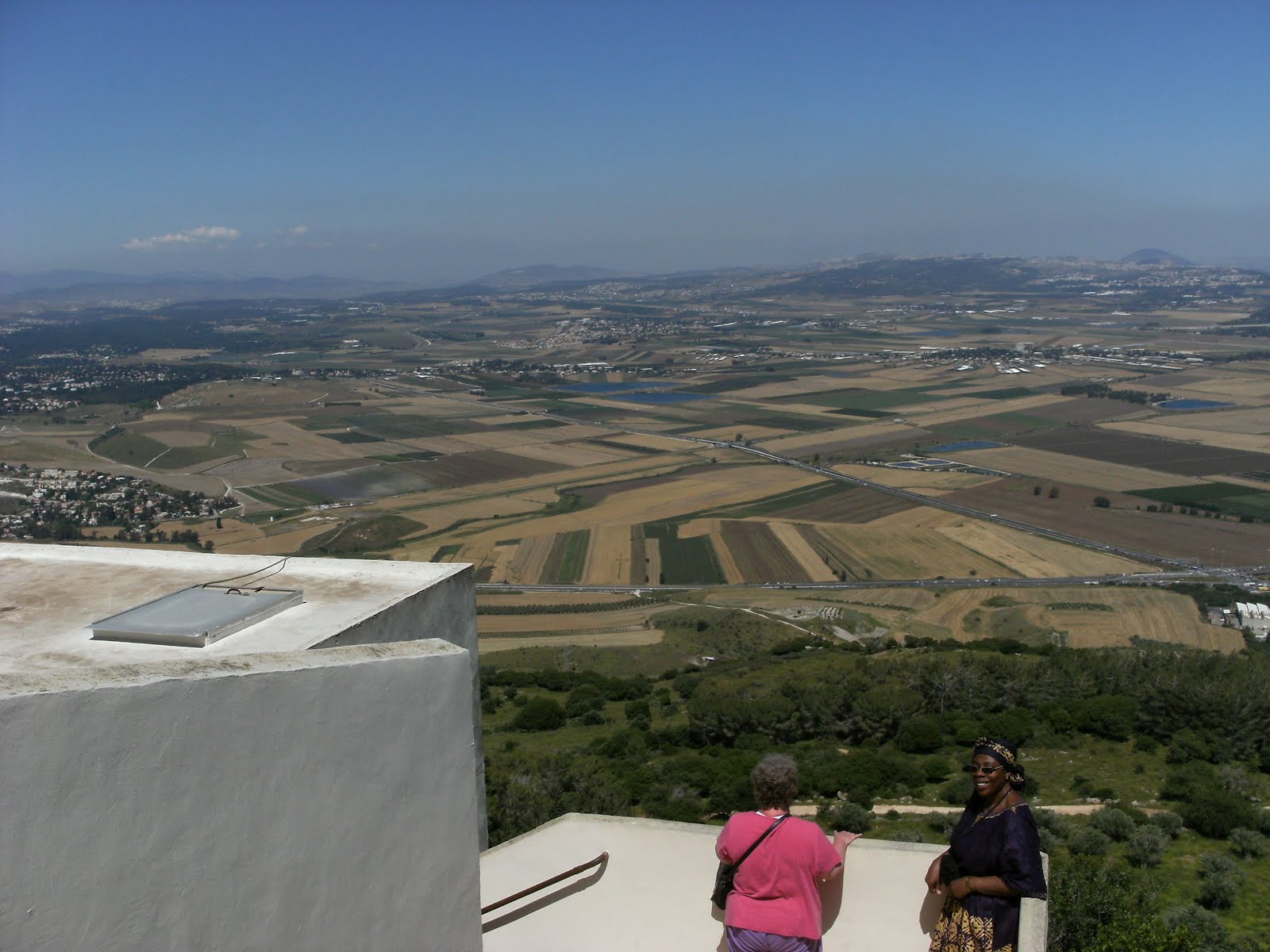
From Megiddo we continued to Haifa and ascended Mount Carmel, the place where Elijah defied the 450 prophets of Baal. And in memory of that outstanding bit of biblical history there is an impressive statue of the prophet Elijah with his sword raised to heaven in triumph over one of the fallen Baal prophets.
However, I learned much more about Mount Carmel. Imagine my surprise when our tour guide told us that the name “Mount Carmel” refers not only to one mountain, which was the one we stood upon (the most important one to visitors in the country), but a range of mountains. In my simple thinking I always thought the name “Mount Carmel” referred to just one mountain. And herein lies the beauty of actually going to historic places and seeing them for oneself.
At the top of the mountain where there is the statue of Elijah, there is also a lot of activity: souvenir shops, chapels and a panoramic view of surrounding areas. I tell you the view from that high place is something else. It is simply beautiful.
Since ancient times Mount Carmel has been known as a sacred place. For example, legends tell that Pythagoras, sixth century Greek mathematician visited Mount Carmel and spoke of it as “the most holy of mountains…” I felt I could have stayed there for hours on Mount Carmel, drinking in its breathtaking beauty, cool breezes and sacred legends which are many.
The name “Mount Carmel” always held an attraction for me and for this same reason I named my ministry after it, e.g. New Vision Ministry of Mount Carmel, in remembrance of Elijah’s great defeat of the 450 prophets of Baal. I have always been enthused by that biblical account. In it, Elijah affirmed his allegiance to Yahweh, God of Israel who rained His fire from heaven upon his altar of sacrifice though much water was poured upon it. Talk about drama and victory! Read all about it at 1 Kings 18:20-46.
There is something about the Holy Land that does a work on you, yet one visit is like the seeing the tip of an iceberg. There is s-o-o-o much to see and do. I hope you will make the trip soon.
It was a full day of activities and we were more than happy to be back at our hotel and look forward to dinner, another teaching by Pastor Peter Youngren, and a well-deserved rest for the night. Next day, we visited Megiddo and Mount Carmel, where the prophet Elijah defeated the worshippers of Baal.
At last, our visit to Megiddo, one of King Solomon’s walled cities in ancient Israel. This place holds a history of ancient palaces, fortresses and temples, and history tells us that King Solomon built a palace there.
Megiddo (which is a Hebrew word) is mentioned in the Book of Revelation as Armageddon (which is Greek) and is said to be the site where the final battle of good and evil will be fought. I collected several small stones on Megiddo to remind me of that final battle, and have placed them in my collection of souvenirs from Israel.
Tradition tells us that on Megiddo there are remains of at least 20 ancient cities built one on top of the other. This tells us that much destruction and rebuilding happened here on Megiddo. You know, when we really stop to think of history, there has been a lot going on in the world from the beginning of time till now! We seem to get caught up with just a small portion of time and it takes a jolt to remind us that the world has been busy for thousands of years, and this becomes more real to us as we visit ancient lands.
From Megiddo we continued to Haifa and ascended Mount Carmel, the place where Elijah defied the 450 prophets of Baal. And in memory of that outstanding bit of biblical history there is an impressive statue of the prophet Elijah with his sword raised to heaven in triumph over one of the fallen Baal prophets.
However, I learned much more about Mount Carmel. Imagine my surprise when our tour guide told us that the name “Mount Carmel” refers not only to one mountain, which was the one we stood upon (the most important one to visitors in the country), but a range of mountains. In my simple thinking I always thought the name “Mount Carmel” referred to just one mountain. And herein lies the beauty of actually going to historic places and seeing them for oneself.
At the top of the mountain where there is the statue of Elijah, there is also a lot of activity: souvenir shops, chapels and a panoramic view of surrounding areas. I tell you the view from that high place is something else. It is simply beautiful.
Since ancient times Mount Carmel has been known as a sacred place. For example, legends tell that Pythagoras, sixth century Greek mathematician visited Mount Carmel and spoke of it as “the most holy of mountains…” I felt I could have stayed there for hours on Mount Carmel, drinking in its breathtaking beauty, cool breezes and sacred legends which are many.
The name “Mount Carmel” always held an attraction for me and for this same reason I named my ministry after it, e.g. New Vision Ministry of Mount Carmel, in remembrance of Elijah’s great defeat of the 450 prophets of Baal. I have always been enthused by that biblical account. In it, Elijah affirmed his allegiance to Yahweh, God of Israel who rained His fire from heaven upon his altar of sacrifice though much water was poured upon it. Talk about drama and victory! Read all about it at 1 Kings 18:20-46.
Friday, October 14, 2011
Reflections on My Trip to Israel - Day 8 of 10


Next morning, breakfast at The Rimonim Hotel was something I will always remember. At the table where Errol and I sat we were privileged to watch the sun rise across the Sea of Galilee.
The fresh, early morning breeze and the rays of the sunrise reflecting on the water and shimmering through the trees were like dancing jewels, and produced a peaceful effect. I wondered: Was it a morning as beautiful as this when Jesus prepared “bread and fish” for His disciples? Did the sunrise reflect on the water just the same and shimmer through the trees just the same when He welcomed his disciples on the beach to “come and dine…?”
Was the water just as peaceful and calm?
After breakfast, Doron took us on a boat trip on the Sea of Galilee. This was something I will always remember. We enjoyed beautiful sunshine, a soft breeze and the knowledge that this was a place Jesus often visited during His lifetime on earth. And at one point, in the middle of the sea, Pastor Peter called for a time of worship and asked the captain of the boat to make a stop. The boat came to a stop and we enjoyed a time of choruses and prayer. But to tell you the truth, I was nervous. In my mind, I was wondering whether the captain, Pastor Peter, the crew and everyone else knew what they were doing.
Remember, I mentioned before that I am afraid of large bodies of water, and as beautiful as the Sea of Galilee is, I would not have liked to go down into it. Besides that, with Jesus not being around physically to help me walk on water as He did with Peter (Matt. 14:29), I knew I would never more be in the land of the living! However, I managed to survive the time of worship even though the boat was rocking from side to side.
We read much about Jesus and the Galilee. And if there was any place I felt His presence it was at the Jordan River and in the region of the Sea of Galilee. To walk in the places where Jesus walked and sail on the sea where Jesus sailed gave me a feeling of awe and humility. Hearing about the Sea of Galilee is one thing, reading about it is another, and actually being there is yet another thing.
I tell you, if ever you visit Israel, and I hope that you will, please make it a must to sail on the Sea of Galilee and visit the Jordan River.
Next, Doron took us to Kibbutz Ginossar where we viewed an ancient boat that dates back to the 1st century AD. This boat was discovered in 1986 on the shore of the Sea of Galilee and experts claimed that this was the type of boat used by people in first century times not only for fishing but also for transport from one side of the lake to the other. A big question is: “Could Jesus have sailed in that boat?” Who knows? We can only speculate, yet it was helpful to us to look closely at an object dating to the time Jesus walked in Galilee and might have used.
Doron, our guide, jokingly warned us not ever to leave the region without eating St. Peter’s fish. He said our trip to the Galilee would be incomplete without tasting that delicious fish and took us to the Ein Gev Fish Restaurant for a sumptuous meal of St. Peter’s fish, chips, and vegetables, complete with Israeli fixings. My goodness, what a spread of food! I tell you, Israel is a vegetarian’s and fish eater’s paradise.
Doron’s insistence about St. Peter’s fish reminded me of a saying in Trinidad about a local fish called “the cascadura” that goes this way: “Those who eat the cascadura will, a native legend says, wheresoever they may wander, end in Trinidad their days.” I wondered if it is the same with St. Peter’s fish and I wondered: Will I end my days in Galilee?
From Galilee we drove to Capernaum, a place that Jesus visited often and saw an ancient synagogue, and the site of the house of Peter. Then we visited the Mount of Beatitudes, the place where Jesus gave His Sermon on the Mount, and drove up the Golan Heights to Caesarea Phillipi.
There is something about the Holy Land that does a work on you, yet one visit is like the seeing the tip of an iceberg. There is s-o-o-o much to see and do. I hope you will make the trip soon.
It was a full day of activities and we were more than happy to be back at our hotel and look forward to dinner and a well-deserved rest for the night. Next day, we visited Mount Carmel where the prophet Elijah defeated the worshippers of Baal.
The fresh, early morning breeze and the rays of the sunrise reflecting on the water and shimmering through the trees were like dancing jewels, and produced a peaceful effect. I wondered: Was it a morning as beautiful as this when Jesus prepared “bread and fish” for His disciples? Did the sunrise reflect on the water just the same and shimmer through the trees just the same when He welcomed his disciples on the beach to “come and dine…?”
Was the water just as peaceful and calm?
After breakfast, Doron took us on a boat trip on the Sea of Galilee. This was something I will always remember. We enjoyed beautiful sunshine, a soft breeze and the knowledge that this was a place Jesus often visited during His lifetime on earth. And at one point, in the middle of the sea, Pastor Peter called for a time of worship and asked the captain of the boat to make a stop. The boat came to a stop and we enjoyed a time of choruses and prayer. But to tell you the truth, I was nervous. In my mind, I was wondering whether the captain, Pastor Peter, the crew and everyone else knew what they were doing.
Remember, I mentioned before that I am afraid of large bodies of water, and as beautiful as the Sea of Galilee is, I would not have liked to go down into it. Besides that, with Jesus not being around physically to help me walk on water as He did with Peter (Matt. 14:29), I knew I would never more be in the land of the living! However, I managed to survive the time of worship even though the boat was rocking from side to side.
We read much about Jesus and the Galilee. And if there was any place I felt His presence it was at the Jordan River and in the region of the Sea of Galilee. To walk in the places where Jesus walked and sail on the sea where Jesus sailed gave me a feeling of awe and humility. Hearing about the Sea of Galilee is one thing, reading about it is another, and actually being there is yet another thing.
I tell you, if ever you visit Israel, and I hope that you will, please make it a must to sail on the Sea of Galilee and visit the Jordan River.
Next, Doron took us to Kibbutz Ginossar where we viewed an ancient boat that dates back to the 1st century AD. This boat was discovered in 1986 on the shore of the Sea of Galilee and experts claimed that this was the type of boat used by people in first century times not only for fishing but also for transport from one side of the lake to the other. A big question is: “Could Jesus have sailed in that boat?” Who knows? We can only speculate, yet it was helpful to us to look closely at an object dating to the time Jesus walked in Galilee and might have used.
Doron, our guide, jokingly warned us not ever to leave the region without eating St. Peter’s fish. He said our trip to the Galilee would be incomplete without tasting that delicious fish and took us to the Ein Gev Fish Restaurant for a sumptuous meal of St. Peter’s fish, chips, and vegetables, complete with Israeli fixings. My goodness, what a spread of food! I tell you, Israel is a vegetarian’s and fish eater’s paradise.
Doron’s insistence about St. Peter’s fish reminded me of a saying in Trinidad about a local fish called “the cascadura” that goes this way: “Those who eat the cascadura will, a native legend says, wheresoever they may wander, end in Trinidad their days.” I wondered if it is the same with St. Peter’s fish and I wondered: Will I end my days in Galilee?
From Galilee we drove to Capernaum, a place that Jesus visited often and saw an ancient synagogue, and the site of the house of Peter. Then we visited the Mount of Beatitudes, the place where Jesus gave His Sermon on the Mount, and drove up the Golan Heights to Caesarea Phillipi.
There is something about the Holy Land that does a work on you, yet one visit is like the seeing the tip of an iceberg. There is s-o-o-o much to see and do. I hope you will make the trip soon.
It was a full day of activities and we were more than happy to be back at our hotel and look forward to dinner and a well-deserved rest for the night. Next day, we visited Mount Carmel where the prophet Elijah defeated the worshippers of Baal.
Friday, September 30, 2011
Reflections on My Trip to Israel - Day 7 of 10


In a massive restoration project for the land of Israel, since 1902 more than 280 million trees have been planted, and to help this project, in connection with the government of Israel, Pastor Peter Youngren has launched the Grace Biblical Forest.
Pastor Peter upholds that the planting of the Grace Biblical Forest “is a unique opportunity to be part of a deeply meaningful, prophetic fulfillment” (Isaiah 32), and he is planting 100,000 trees, many of which are fruit-bearing. To this end, Errol and I grasped the opportunity to leave a tree planted in Israel in our names. So we have a tree, basking in the sunshine of Israel and serving a worthwhile purpose in that land which means much to us.
Pastor Peter upholds that the planting of the Grace Biblical Forest “is a unique opportunity to be part of a deeply meaningful, prophetic fulfillment” (Isaiah 32), and he is planting 100,000 trees, many of which are fruit-bearing. To this end, Errol and I grasped the opportunity to leave a tree planted in Israel in our names. So we have a tree, basking in the sunshine of Israel and serving a worthwhile purpose in that land which means much to us.
We drove through the Jordan (Rift) Valley to Beit She’an, an ancient city that has existed since the time of King Saul and visited the remains of a Roman theatre (circa 1 AD) that has been excavated there. On that day it was blazing hot, and as usual, at every place we visited, I looked for two things: a cool, shady spot and a place to sit, but this time I did not find either of that, so I just had to deal with the heat as I admired the view.
I could just imagine the grandeur of Beit She’an and the Roman theatre in its hey day 6,000 years ago. The theatre boasted a semi-circular design cut into the hillside and seated 7,000 people in rows of limestone seats. In my imagination I could see the crowds and sporting events, and other entertainment of the day. In that place in particular, we were so close to ancient history, we could almost touch it.
There are still ongoing excavations taking place in Beit She’an. You can see the remains of the theatre in one of today’s pictures….who knows what else will be unearthed! If ever you go to Israel, Beit She’an should be a must-visit place on your list.
Another must-visit place on your list should be Nazareth Village, which is very interesting! This is a village scene created in Nazareth that shows the way the community looked in Jesus’ early years. It is a live scenario that really gave us the feel of first century living, with a show-and-tell atmosphere. Visit their website here www.nazarethvillage.com.
It is not as hectic Church of the Holy Sepulchre or the Church of the Nativity or even the Via Dolorosa, but it is a quiet, rural setting with shepherds and grazing sheep. However, there was much uphill climbing on rocky, rough terrain.
Imagine how it was in those days…no supermarkets, no refrigeration for food, no fast foods, and all work was manual with home-made equipment and carpentry tools, and every meal was prepared from scratch.
At Nazareth Village, men and women wore traditional first-century garb, moving around gracefully as they demonstrated how chores were done in those early days. They showed us how wool was spun, dyed and woven to make clothing. The cloths were dyed with onion skins for brown colours, and specific fruits for other colours.
They showed how garments were made, how wine was made, how grain was ground, how olives were pressed to extract oil, and how sheep were raised. It was a step into the past to catch a glimpse of how life was in Jesus’ boyhood days.
Another interesting stop on that day was at Cana of Galilee where Jesus did His first miracle of turning water into wine at a wedding. Frankly, I always wonder why Jesus bothered to turn water into wine for the guests at the wedding. He could have easily told them to go home because the wine had run out…
We saw Mary’s Well where tradition says that Mary, while fetching water from the well, received the announcement from the angel Gabriel that she would bring forth Jesus, our Saviour. The well is fed from a spring called Mary’s Spring. And though the place of the annunciation is not recorded in the Bible, the traditional account is very ancient.
Then there was baptism in the Jordan River. One can never imagine the feeling of being at the very river where Jesus was baptized and the Spirit descending like a dove upon Him. We might not know the exact spot of Jesus’ baptism, but we know it was the Jordan River, and knowing this does something to the believer’s soul. I lost count of how many were baptized by Pastor Peter Youngren in the Jordan on that day, but I know there were many. In some places the Jordan is just a mere stream but at the place for baptism it is a mighty river.
We spent that night at the Rimonim Hotel and were in time for the May 14th celebration of Israel’s 63 years as a nation. It was great to be in time for celebrating Israel’s national birthday with her. As I reflected on the occasion, I realized that Errol and I chose the right time to visit Israel: just at her national birthday. At a park near our hotel there was a lot of celebration going on. Partygoers had a great time in the park all night having fun, fireworks, singing and dancing.
That evening, after dinner, we had another dynamic teaching by Pastor Peter and eagerly looked forward to the next day when we would be going on a boat ride on the Sea of Galilee!
I could just imagine the grandeur of Beit She’an and the Roman theatre in its hey day 6,000 years ago. The theatre boasted a semi-circular design cut into the hillside and seated 7,000 people in rows of limestone seats. In my imagination I could see the crowds and sporting events, and other entertainment of the day. In that place in particular, we were so close to ancient history, we could almost touch it.
There are still ongoing excavations taking place in Beit She’an. You can see the remains of the theatre in one of today’s pictures….who knows what else will be unearthed! If ever you go to Israel, Beit She’an should be a must-visit place on your list.
Another must-visit place on your list should be Nazareth Village, which is very interesting! This is a village scene created in Nazareth that shows the way the community looked in Jesus’ early years. It is a live scenario that really gave us the feel of first century living, with a show-and-tell atmosphere. Visit their website here www.nazarethvillage.com.
It is not as hectic Church of the Holy Sepulchre or the Church of the Nativity or even the Via Dolorosa, but it is a quiet, rural setting with shepherds and grazing sheep. However, there was much uphill climbing on rocky, rough terrain.
Imagine how it was in those days…no supermarkets, no refrigeration for food, no fast foods, and all work was manual with home-made equipment and carpentry tools, and every meal was prepared from scratch.
At Nazareth Village, men and women wore traditional first-century garb, moving around gracefully as they demonstrated how chores were done in those early days. They showed us how wool was spun, dyed and woven to make clothing. The cloths were dyed with onion skins for brown colours, and specific fruits for other colours.
They showed how garments were made, how wine was made, how grain was ground, how olives were pressed to extract oil, and how sheep were raised. It was a step into the past to catch a glimpse of how life was in Jesus’ boyhood days.
Another interesting stop on that day was at Cana of Galilee where Jesus did His first miracle of turning water into wine at a wedding. Frankly, I always wonder why Jesus bothered to turn water into wine for the guests at the wedding. He could have easily told them to go home because the wine had run out…
We saw Mary’s Well where tradition says that Mary, while fetching water from the well, received the announcement from the angel Gabriel that she would bring forth Jesus, our Saviour. The well is fed from a spring called Mary’s Spring. And though the place of the annunciation is not recorded in the Bible, the traditional account is very ancient.
Then there was baptism in the Jordan River. One can never imagine the feeling of being at the very river where Jesus was baptized and the Spirit descending like a dove upon Him. We might not know the exact spot of Jesus’ baptism, but we know it was the Jordan River, and knowing this does something to the believer’s soul. I lost count of how many were baptized by Pastor Peter Youngren in the Jordan on that day, but I know there were many. In some places the Jordan is just a mere stream but at the place for baptism it is a mighty river.
We spent that night at the Rimonim Hotel and were in time for the May 14th celebration of Israel’s 63 years as a nation. It was great to be in time for celebrating Israel’s national birthday with her. As I reflected on the occasion, I realized that Errol and I chose the right time to visit Israel: just at her national birthday. At a park near our hotel there was a lot of celebration going on. Partygoers had a great time in the park all night having fun, fireworks, singing and dancing.
That evening, after dinner, we had another dynamic teaching by Pastor Peter and eagerly looked forward to the next day when we would be going on a boat ride on the Sea of Galilee!
Thursday, September 22, 2011
Reflections on My Trip to Israel - Day 6 of 10


Day 6, Sunday, was our free day. We were not taken to visit sites anywhere and were told we could spend the day in any way we chose. I planned on reading, relaxing and catching up on my journalling and emails to home.
Our guide, Doron, had encouraged us to visit Ben Yehuda Street and do some shopping. He also told us how to get there by bus or taxi. He said some of the most expensive and beautiful merchandise in Jerusalem can be found on Ben Yehuda Street.
However, Errol and I did not go to Ben Yehuda Street, but later, when I heard from three women about beautiful fabrics they bought there, I wished I had made the effort to go shopping on Ben Yehuda Street. Carla, Sherry and Karen talked about the store owner knowing a lot about fabrics and accessories and they asked him how he knew so much about fabrics. He told them it was because his wife used to sew a lot and this is how he learned about it. She is no longer in the land of the living but left him a legacy of knowledge about the merchandise he sells.
I have an addiction for beautiful fabrics, and though I have a ton of fabrics at home in every design, colour and texture, a couple pieces more, especially from Israel, would not have hurt my inventory. Oh, how I wish I had gone to shop at Ben Yehuda Street!
Our guide, Doron, had encouraged us to visit Ben Yehuda Street and do some shopping. He also told us how to get there by bus or taxi. He said some of the most expensive and beautiful merchandise in Jerusalem can be found on Ben Yehuda Street.
However, Errol and I did not go to Ben Yehuda Street, but later, when I heard from three women about beautiful fabrics they bought there, I wished I had made the effort to go shopping on Ben Yehuda Street. Carla, Sherry and Karen talked about the store owner knowing a lot about fabrics and accessories and they asked him how he knew so much about fabrics. He told them it was because his wife used to sew a lot and this is how he learned about it. She is no longer in the land of the living but left him a legacy of knowledge about the merchandise he sells.
I have an addiction for beautiful fabrics, and though I have a ton of fabrics at home in every design, colour and texture, a couple pieces more, especially from Israel, would not have hurt my inventory. Oh, how I wish I had gone to shop at Ben Yehuda Street!
Anyway, Ben Yehuda Street is on my list for my next visit to Israel, which I hope will be soon.
Errol and I were not the only ones who did not go to Ben Yehuda Street. We met with others and chatted with them about our past week and shared about what our pilgrimage to the Holy Land meant to us. As for me, it was the living reality of a long-time dream about 20 years in the making. I have always been attracted to the culture and language of Israel and it felt good to be in the land related to the Patriarchs and Prophets of old and where Jesus walked, taught and did His many healings and miracles.
We talked also about the Jerusalem Syndrome, which Pastor Peter Youngren told us about quite early in our pilgrimage, and had laughingly warned us not to catch the “disease.” The Jerusalem Syndrome is some sort of psychotic disorder, which many pilgrims experience on their visit to Israel. They imagine weird ideas about themselves relating to biblical characters and historical places, maybe it is because of being in the environment where so much biblical history took place. This does a spin in the human psyche of most individuals, weaving a fantasy in their minds causing them to think in an inadvertent way. For example, we heard of one man on Mount Carmel who thought he was Elijah re-visiting the area. This is just one small incident.
Jerusalem is a charismatic place, and I use the term “charismatic” in a loving way. As a pilgrim, being in that city takes a hold on you. It grows on you. Maybe it is because of one’s biblical knowledge and it gives the reality of being close to places God performed His mighty works, especially in Old Covenant times.
The pursuit of tracking events in ancient Jerusalem is a magnificent obsession and many pilgrims, including myself, can never seem to get enough of it. However, I did not catch the Jerusalem Syndrome but caught a cold because of not being dressed warmly enough early one morning.
Remember in my first post there is a photo of a man with a camel and he is carrying a stick? He was soliciting patrons to take a picture either standing next to the camel or sitting on it for a fee of $20.00. The thing is, in order to climb on the camel it had to kneel. The poor animal’s knees were sore from kneeling on asphalt and stone and I could not see how anyone would be a party in putting the animal through that distress. For this reason, even though it meant “bread and butter” for his owner’s table, I did not take a picture with the camel.
More about our pilgrimage next week...
Errol and I were not the only ones who did not go to Ben Yehuda Street. We met with others and chatted with them about our past week and shared about what our pilgrimage to the Holy Land meant to us. As for me, it was the living reality of a long-time dream about 20 years in the making. I have always been attracted to the culture and language of Israel and it felt good to be in the land related to the Patriarchs and Prophets of old and where Jesus walked, taught and did His many healings and miracles.
We talked also about the Jerusalem Syndrome, which Pastor Peter Youngren told us about quite early in our pilgrimage, and had laughingly warned us not to catch the “disease.” The Jerusalem Syndrome is some sort of psychotic disorder, which many pilgrims experience on their visit to Israel. They imagine weird ideas about themselves relating to biblical characters and historical places, maybe it is because of being in the environment where so much biblical history took place. This does a spin in the human psyche of most individuals, weaving a fantasy in their minds causing them to think in an inadvertent way. For example, we heard of one man on Mount Carmel who thought he was Elijah re-visiting the area. This is just one small incident.
Jerusalem is a charismatic place, and I use the term “charismatic” in a loving way. As a pilgrim, being in that city takes a hold on you. It grows on you. Maybe it is because of one’s biblical knowledge and it gives the reality of being close to places God performed His mighty works, especially in Old Covenant times.
The pursuit of tracking events in ancient Jerusalem is a magnificent obsession and many pilgrims, including myself, can never seem to get enough of it. However, I did not catch the Jerusalem Syndrome but caught a cold because of not being dressed warmly enough early one morning.
Remember in my first post there is a photo of a man with a camel and he is carrying a stick? He was soliciting patrons to take a picture either standing next to the camel or sitting on it for a fee of $20.00. The thing is, in order to climb on the camel it had to kneel. The poor animal’s knees were sore from kneeling on asphalt and stone and I could not see how anyone would be a party in putting the animal through that distress. For this reason, even though it meant “bread and butter” for his owner’s table, I did not take a picture with the camel.
More about our pilgrimage next week...
Subscribe to:
Posts (Atom)